The classic PLG funnel, signup, activate, convert, is outdated. It doesn’t capture the specific DNA of a PLG/PLS led company.
The flywheel model gives us a better structure: a loop of evaluation, activation, adoption, and expansion. But in most teams, it’s still just theory. It doesn’t tell you what to do when a lead is stuck in one stage, or how to operationalize movement between stages.
So we’ve reworked it, built from real GTM workflows, to help operators spot gaps, define exit criteria, and design plays for every stage.
This is the modern PLG flywheel you should be running on.
The Operator Map #
Use this to audit your current PLG motion. For each stage, ask: Are we treating users the right way, at the right time, with the right ownership?
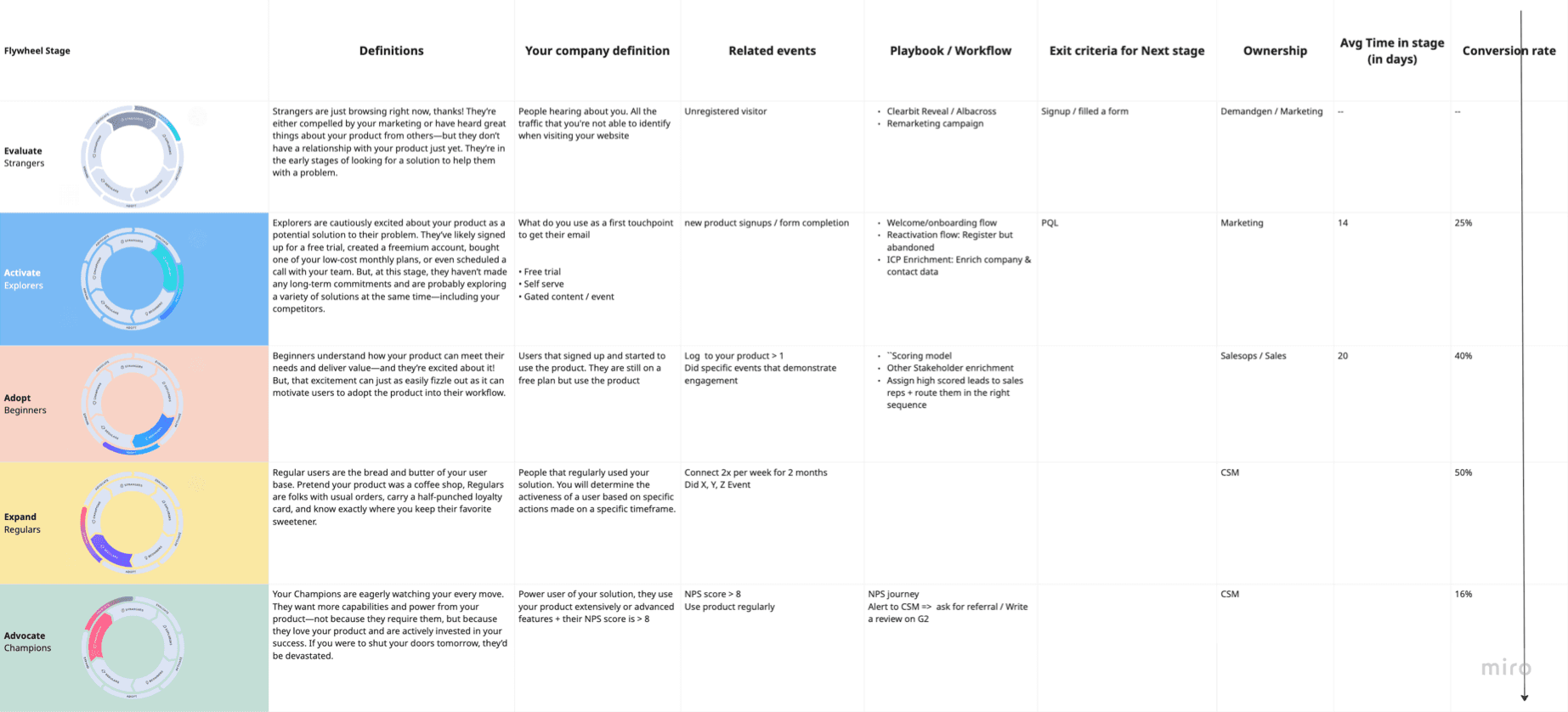
The Modern PLG Flywheel #
1. Evaluate, Strangers #
At the Evaluate stage, users are just beginning to explore. They’re browsing your site anonymously, maybe intrigued by your marketing, maybe not ready to engage yet.
Goal: Surface interest and capture intent.
Playbook: Use tools like Clearbit Reveal or Albacross to de-anonymize traffic, run remarketing campaigns, and drive soft conversions.
Exit Criteria: Signup or form fill.
Ownership: Demand Gen / Marketing
2. Activate, Explorers #
New signups are Explorers. They’re cautiously excited but noncommittal, testing your product alongside others.
Goal: Drive fast Time-to-Value (TTV) and start firmographic enrichment.
Playbook: Welcome/onboarding flows, reactivation nudges for abandons, ICP enrichment.
Exit Criteria: Achieve PQL status (product-qualified based on usage + fit).
Ownership: Marketing
3. Adopt, Beginners #
Beginners understand your value proposition and have begun integrating it into their workflows, even if they’re still on free plans.
Goal: Deepen engagement and identify other key stakeholders.
Playbook: Scoring models based on engagement, stakeholder enrichment, routing high-scoring leads to reps.
Exit Criteria: Sustained product usage + second-order behaviors (invites, API calls).
Ownership: Sales Ops / Sales
4. Expand, Regulars #
Regulars are active users who are ripe for upsell or expansion.
Goal: Identify account growth opportunities based on product signals.
Playbook: Monitor key events (feature adoption, increased usage volume), trigger CSM outreach.
Exit Criteria: Expansion event (new seats, upgraded plans).
Ownership: CSM
5. Advocate, Champions #
Champions are your best users, advocating internally and externally.
Goal: Turn usage love into public love.
Playbook: NPS programs, CSM-led referral asks, review and testimonial campaigns.
Exit Criteria: Advocacy action (review, referral, case study).
Ownership: CSM
How to Build Systems for Each Stage #
Every stage requires:
- Clear triggers to move users forward.
- Playbooks tailored to behaviors, not just lifecycle stages.
- Ownership split cleanly across Marketing, Sales, and CS teams.
Metrics also need to evolve. It’s not just “activation rate” anymore. It’s about measuring stage progression, activation, adoption, expansion, and advocacy, in a continuous loop.
Why This Flywheel Outperforms Traditional Funnels #
Funnels end. Flywheels spin.
By designing around a flywheel, you:
- Capture longer, more complex user journeys.
- Build revenue systems that optimize for expansion and advocacy, not just acquisition.
- Create a full-funnel orchestration motion where product, sales, and marketing work off the same signals.
Final Take #
Modern PLG isn’t linear. It’s a continuous system of evaluation, activation, adoption, expansion, and advocacy.
GTM teams that use the framework above, turn a theoretical framework into an actionable way of identifying gaps in the prospect / customer journey, and create sub processes accordingly. For this reality isn’t just growing faster. They’re compounding their growth at every stage.
Key Takeaways #
- Classic PLG funnel (signup → activate → convert) is outdated: Doesn’t capture complex user journeys or tell you what to do when leads are stuck, how to move them between stages, or where gaps exist, purely theoretical, not operationalizable
- Modern PLG flywheel = 5 continuous stages with clear ownership: Evaluate (strangers → Marketing), Activate (explorers → Marketing), Adopt (beginners → Sales Ops/Sales), Expand (regulars → CSM), Advocate (champions → CSM), each with goal, playbook, exit criteria
- Funnels end, flywheels spin, continuous loop compounds growth: Evaluate → Activate → Adopt → Expand → Advocate → back to Evaluate (referrals, advocacy), captures longer journeys, optimizes for expansion/advocacy (not just acquisition), creates full-funnel orchestration where product/sales/marketing work off same signals
- Exit criteria define stage progression (not just time-based): Evaluate (signup/form fill), Activate (PQL status: usage + ICP fit), Adopt (sustained usage + second-order behaviors: invites, API calls), Expand (expansion event: new seats, upgraded plans), Advocate (advocacy action: review, referral, case study)
- Each stage requires clear triggers, tailored playbooks, metrics: Evaluate (de-anonymize traffic via Clearbit Reveal), Activate (welcome flows, TTV, enrichment), Adopt (scoring models, stakeholder enrichment, routing to reps), Expand (feature adoption triggers, CSM outreach), Advocate (NPS programs, referral asks, testimonials), measure stage progression, not just “activation rate”
Frequently Asked Questions #
Traditional funnels are linear and one-directional, users move from signup to conversion, then it ends. This fails to capture: complex user journeys (users bounce between stages, re-activate after dormancy, expand multiple times), what to do when users are stuck (no playbooks per stage), ownership clarity (who owns activation vs. expansion?), or continuous growth (ignores advocacy, referrals feeding back into top-of-funnel).
Result: Theory without operationalization. Teams can’t identify gaps, design targeted plays, or optimize each stage independently. Flywheels solve this by creating continuous loops with clear stage definitions, exit criteria, and ownership.
1. Evaluate (Strangers → Marketing): Anonymous site visitors, browsing content. Goal: Capture intent. Playbook: De-anonymize traffic (Clearbit Reveal), remarketing. Exit: Signup/form fill.
2. Activate (Explorers → Marketing): New signups testing product. Goal: Fast TTV + enrichment. Playbook: Onboarding flows, reactivation nudges, ICP enrichment. Exit: PQL (usage + fit).
3. Adopt (Beginners → Sales Ops/Sales): Integrated into workflows, free or paid. Goal: Deepen engagement, find stakeholders. Playbook: Scoring, stakeholder enrichment, routing to reps. Exit: Sustained usage + second-order behaviors (invites, API calls).
4. Expand (Regulars → CSM): Active users ripe for upsell. Goal: Growth opportunities. Playbook: Monitor feature adoption, trigger CSM. Exit: Expansion event (seats, plan upgrades).
5. Advocate (Champions → CSM): Best users, internal/external advocates. Goal: Public love. Playbook: NPS, referrals, testimonials. Exit: Advocacy action (review, case study).
Each stage needs: Clear triggers (what moves users forward), Tailored playbooks (actions based on behaviors, not time), Metrics (stage progression rates, not just top-line).
Example, Activate → Adopt:
- Trigger: User hits PQL threshold (3 key actions in product + ICP firmographic fit)
- Playbook: Enrich user (find job title, LinkedIn), enrich account (find other stakeholders using domain), score account (fit + engagement), route to appropriate tier (Tier 1 → AE white-glove, Tier 2 → standard AE, Tier 3 → automated nurture)
- Metric: PQL-to-Adopt conversion rate (% of PQLs who sustain usage for 30+ days and invite teammates)
Without operationalization, users get stuck, signups who never activate, PQLs who never convert, customers who never expand.
Funnels end, flywheels spin, continuous compounding:
1. Captures longer journeys: Users don’t move linearly. They re-engage after dormancy, expand multiple times, advocate then buy more. Funnels can’t model this; flywheels embrace it.
2. Optimizes for expansion and advocacy, not just acquisition: Traditional funnels focus on signup → paid conversion. Flywheels treat expansion (Regulars → upsell) and advocacy (Champions → referrals feeding new Strangers) as core growth engines.
3. Creates full-funnel orchestration: Product usage signals, sales activities, marketing campaigns all work off same flywheel stages. Example: Product detects “Expand” signal (feature adoption spike) → Triggers CSM workflow → CSM books upsell meeting → Marketing targets similar accounts.
Result: Every stage compounds the next. Advocates create new Evaluators, Expanders create new product data to optimize Activation, etc.
Marketing owns Evaluate + Activate:
- Evaluate: Capture anonymous intent, drive signups (demand gen, remarketing, content)
- Activate: Onboarding, TTV optimization, reactivation campaigns, ICP enrichment
Sales Ops + Sales own Adopt:
- Sales Ops: Build scoring models, enrichment workflows, routing logic
- Sales: High-touch engagement with PQLs (AEs focus on Tier 1/2 accounts)
CS owns Expand + Advocate:
- Expand: Monitor usage signals, trigger upsell conversations, execute expansion plays
- Advocate: NPS programs, referral asks, testimonial/case study creation
Key: Clean handoffs with clear exit criteria. Marketing doesn’t dump all signups to Sales, only PQLs. Sales doesn’t hand off all customers to CS, only those hitting sustained usage thresholds. Ownership clarity = no gaps, no duplicated effort.
👉 Interested in learning more about PLG? Check out our PLG resources
 MaxJul 18, 2025