"Unstructured data is your edge. While many AI use cases will become standard, what wins is being first to get the upside before results normalize. Companies with unique data sets will have outsized wins. Prioritize plays where your data gives you leverage over competitors."
In today’s GTM arms race, every team has ZoomInfo or Apollo. So why does everyone’s outreach feel the same? Because the real edge isn’t in tools. To stand out, you need custom, actionable data points, and a way to operationalize them at scale.
After we posted about our workshop on custom data points, many GTM operators reached out asking not just what to use, but how to put it into practice. Here’s how the 1% actually do it.
We’ll get into why relying on generic data alone is dead, how LLMs unlock custom insights at scale, and the exact systems operators build to turn custom attributes and signals into a repeatable GTM engine.
Here’s the actual playbook:
Extract: Find the custom datapoints that matter for your business-specific needs.
Operationalize: Wire those attributes into scoring, routing, and messaging flows.
Refresh: Make sure every play adapts in real-time. Stale data = dead data.
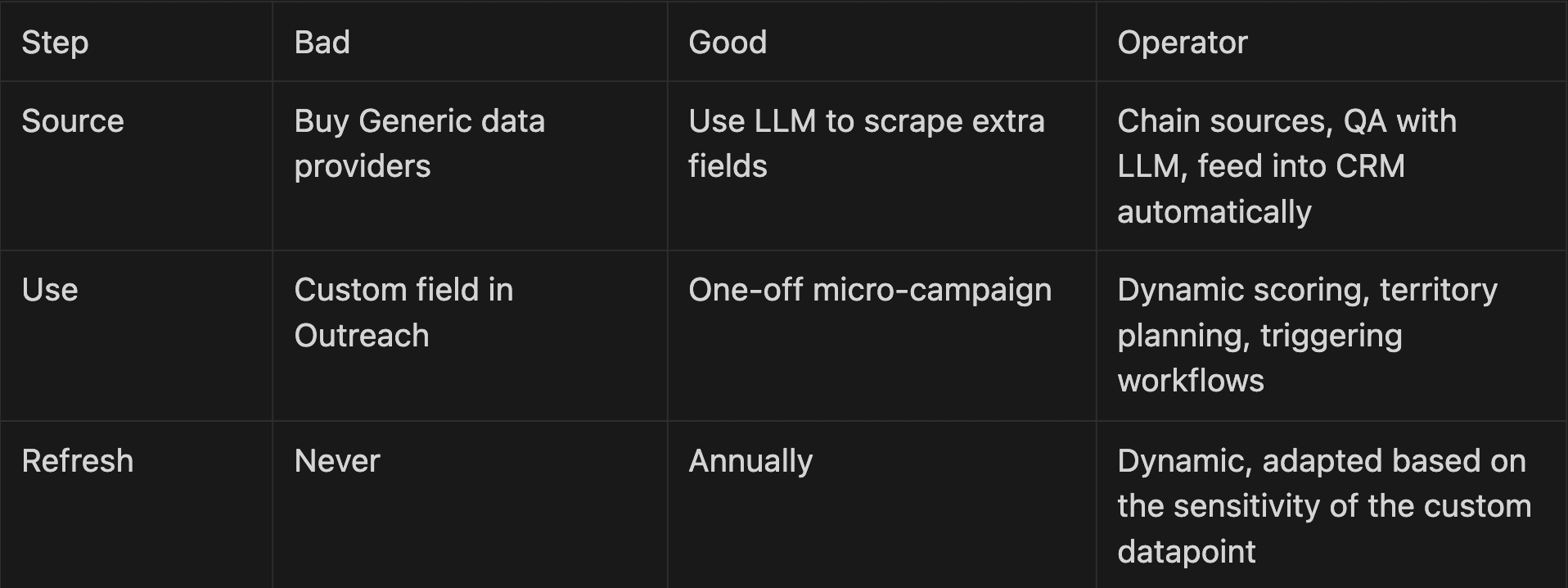
1. Why Third-Party Data Falls Short #
Everyone’s been there: you bought a third-party data provider, hoping for an edge, just to realize a bit later that it’s the same standard-issue lists each of your competitors is using. While it’s a good starting point, we all know the limitations:
- Commoditized: Your competitors have the same data, removing your edge.
- Inaccurate/outdated: Missing or stale information (headcount, revenue, role changes). Ever check a lead on LinkedIn before reaching out, only to see they left six months ago? If you know, you know.
- Overly broad: “Software Development” lumps distinct segments together, and legit SaaS companies are often hidden in other categories.
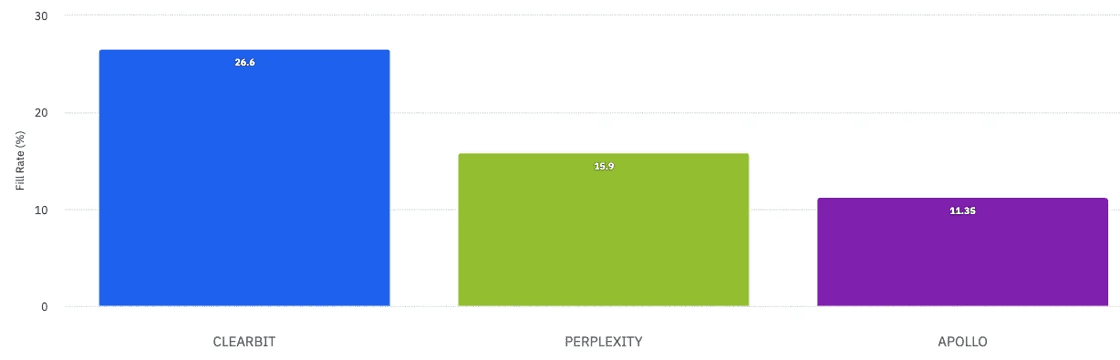
Currently, LLMs outperform most providers in basic company data, especially information that is publicly available. For instance, a recent analysis by Syftdata revealed that Perplexity provided 40% more data on “annual revenue” than Apollo.
With tools like Perplexity or Cargo Agent, you can extract hyper-specific, structured data at scale to fill the gaps, enrich what’s missing, and customize your dataset for your actual go-to-market needs. It’s about transforming generic baseline data into something truly actionable and proprietary to your company.
2. The LLM Era: Custom Data at Scale #
LLMs are changing how we source insights.
LLMs now pull custom, business-specific data points at scale from the public web, press releases, job boards, even investor reports. And you can pipe them straight into your CRM.
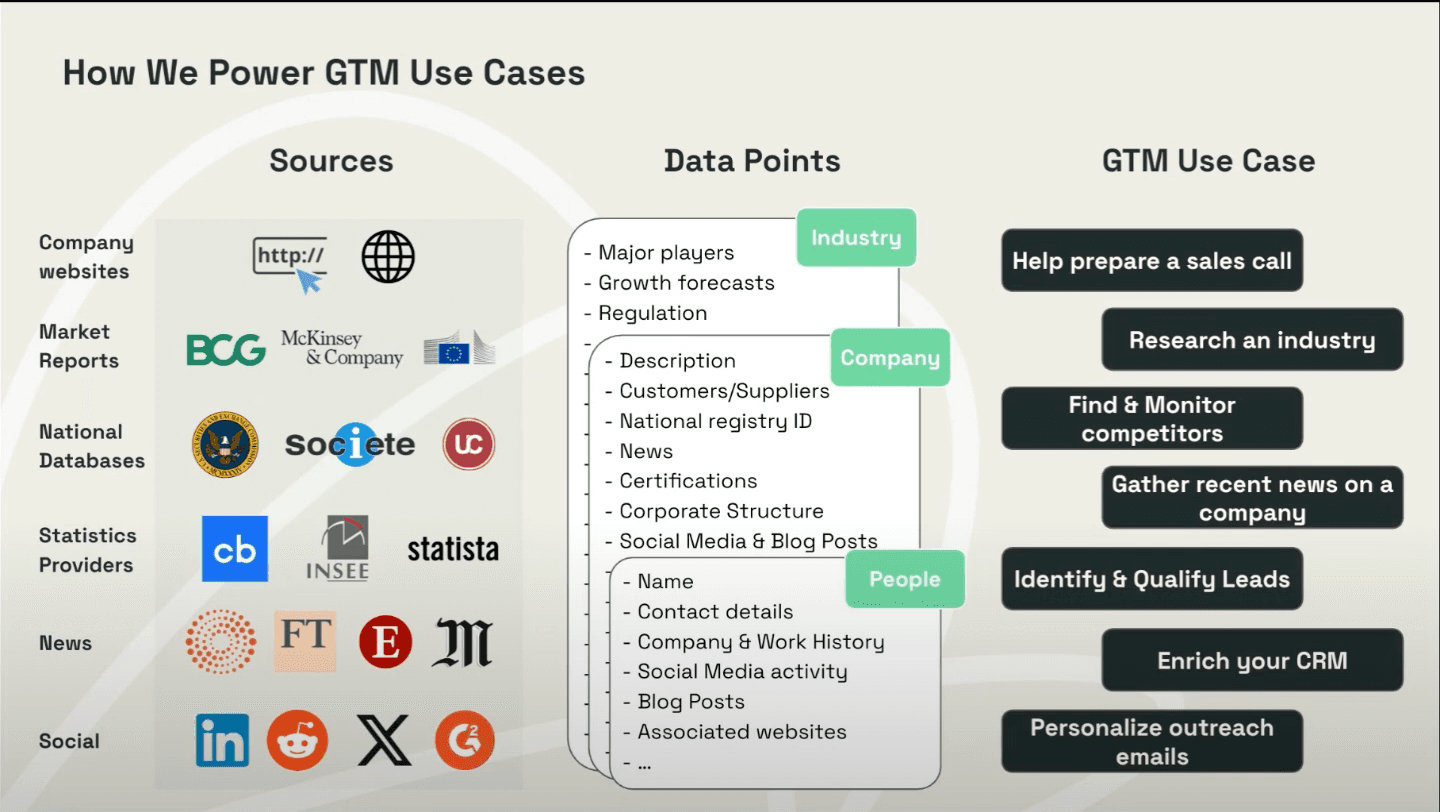
Examples:
- Vanta: Does this company have SOC2 Type II?
- Rippling: Are they hiring people outside of HQ locations?
- Sweep: Are they running sustainability initiatives?
- Yoobic: How many physical stores does a company have?
If you’re running campaigns with these, you outperform anyone blasting generic lists. You show up with context that moves the needle.
Operator Tip: If a specific data seems difficult to retrieve, use an indicator (0-10 scale) to estimate likelihood and combine it with confidence scoring for reliability. Ex: On a scale from 0-10, how much do you think {{ company_name }} is hiring remotely? When doing this, it’s very important to also ask AI to provide you with a confidence score and explanation.
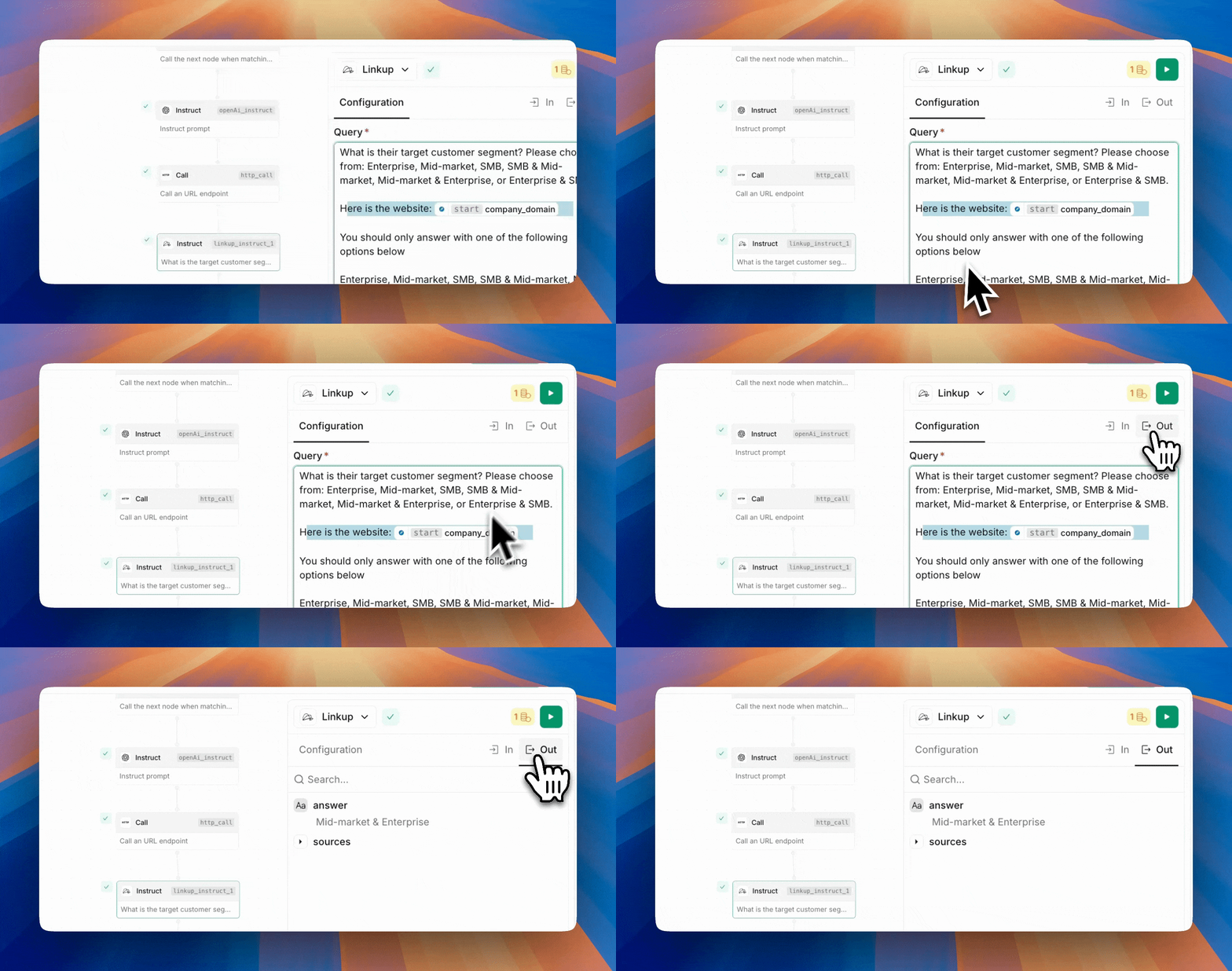
The best custom data points come from deep knowledge of your target market.
Ask yourself: If I had a list of 10 companies, what attribute or signal would make me pick one as a “perfect fit” over the others?
If you’re not sure, just ask our new best friend: AI.
You can use the ChatGPT Cargo Agent. Just ask: “Give me custom datapoints & signals for domain.com”
Examples by vertical:
- Sales engagement tools: Number of reps, split between AE/BDR, GTM stack, outbound/inbound pipeline mix, sales enablement headcount.
- Fintech: FX risk (operating in multiple countries), treasury team presence, payment processor.
- AI dev tools: Ratio of junior/senior devs, ML hiring, DevOps stack (IDE, CI/CD), growth or decline of engineers (you can have a “do more with less” angle if your solution brings efficiency).
- Retail tech: Physical store count, seasonality, new market entries.
And so on. If it’s generic, it’s not an edge. If it’s hard to pull, but matters for closing, it is.
Here’s the wild part: less than 1% of teams are operationalizing custom data at scale.
Most teams stop at using this data for micro-campaigns. Top 1% operators, though, build these custom data & signals into the very foundation of how they sell, segment, and assign.
3. The Operator Playbook: Turning Custom Data Into GTM Advantage #
Surfacing custom data is actually quite easy. Most teams use custom data for micro-campaigns, which is good, but 1% operators wire it into their entire GTM engine:
- Scoring every account by custom attributes and dynamic signals, not static firmographics.
- Redesigning territories, not by geo or company size, but by deal potential and strategic fit.
- Trigger sequences that speak to a prospect’s real world, not just “Hey, saw you’re in SaaS.”
Let’s see how to operationalize it.
A. Scoring & Segmentation
Custom attributes aren’t just for outreach, they power dynamic scoring models.
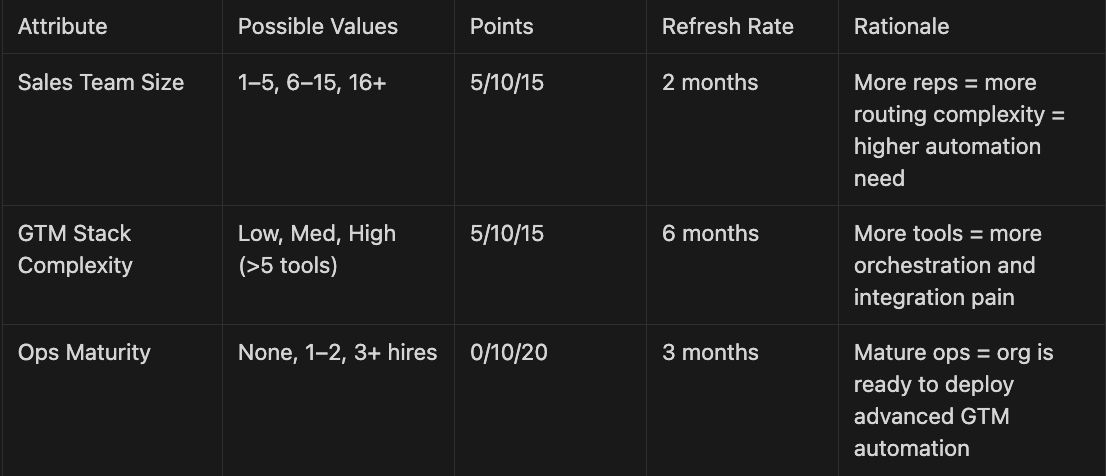
The goal is a dynamic scoring system. As new data comes in, maybe a company just doubled their SDR headcount, or switched to Salesforce, your model automatically recalculates, and those accounts move up (or down) in priority.
The key: This is a living system. Every time the data refreshes, so does your focus. No more static territories, no more outdated scoring, no more dead pipeline.
B. Tiering & Resource Allocation
The goal is to allocate the right resources (i.e., human versus automation/AI agent) based on revenue potential. You need to find the right balance between maximizing engagement and ensuring that most shiny accounts receive white-glove, human-led treatment.
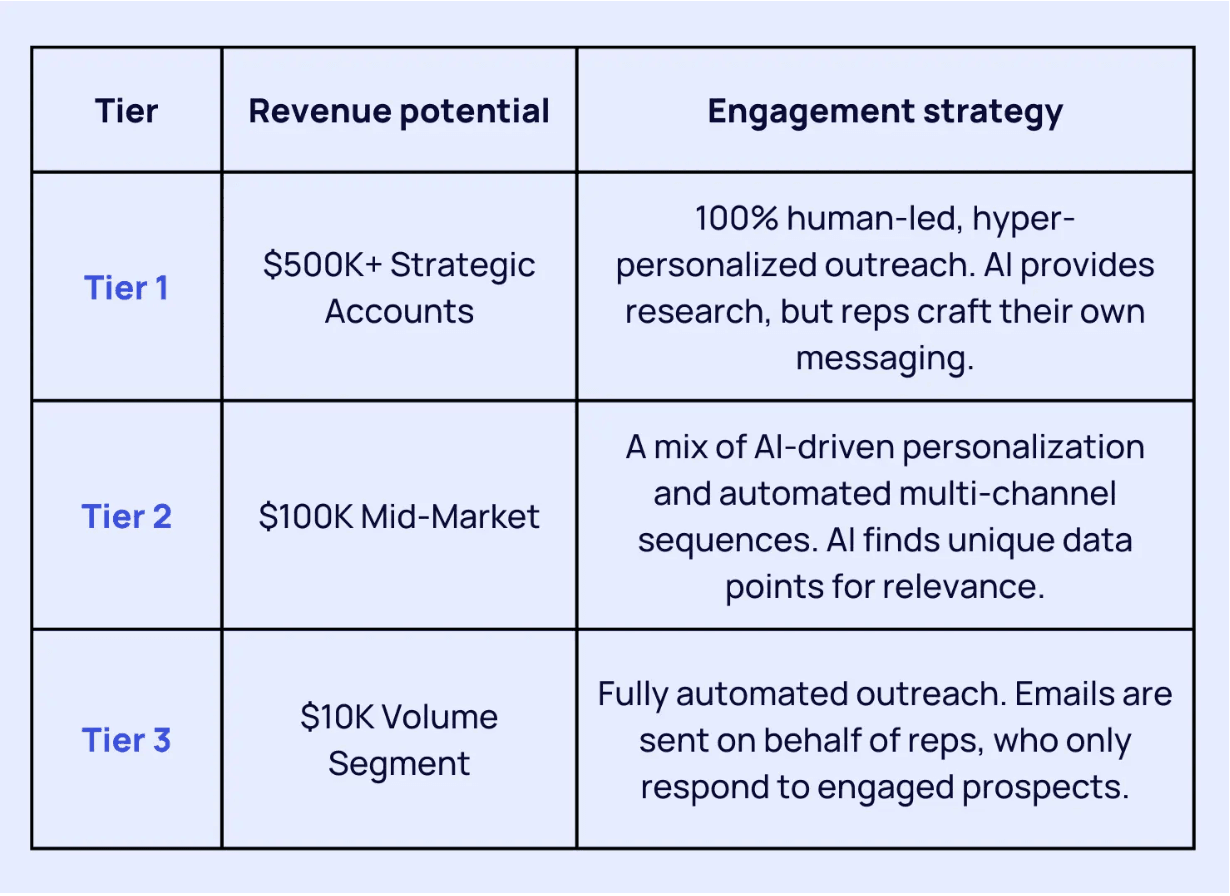
When you deeply understand a prospect’s GTM setup and priorities, you can craft messaging that resonates at a strategic level, even if it’s automated.
Highly relevant outreach can even outperform signal-based strategies.
Examples:
-
Vanta
Knowing a company’s target market and their SOC 2 status (e.g., Type 1, Type 2, or not certified) can be the difference between closing or losing a deal. If a company is selling to mid-market or enterprise customers but lacks full SOC 2 compliance, that gap can kill deals late in the cycle. With this datapoint, you can lead with messaging like:
“Selling to companies like Ramp or Miro is tough when you’re not SOC 2 compliant. There’s nothing more frustrating than getting the team excited, only to get a cold ‘no’ from security at the finish line. Let’s make sure compliance never stalls your next big win.”
Here again, finding the customer logos of a target company can easily be done at scale with LLMs. This is the power of a well-chosen custom datapoint: it lets you speak directly to a pain the company may not even realize is costing them revenue.
-
Deel
It’s not enough to know if a company is remote. What matters is how globally distributed they are, if they have people working outside of HQ locations, and whether they have the infrastructure to handle compliance, contracts, and payroll across borders.
Three interesting custom data points could be:
- Founded year: Younger companies are more likely to be remote-native; older companies often struggle with global compliance complexity.
- Geographic distribution of employees: If a company has team members across 5+ countries but no legal entities in those regions, it’s a perfect Deel fit.
- Employee growth rate: If they are growing fast in those locations, they will need to have a proper solution to maintain the hiring pace.
This allows for messaging like:
“Hiring in 6+ countries without local entities? Growing fast but stuck dealing with contracts, currencies, or misaligned benefits? We see this all the time, and it’s why companies like X and Y switched to Deel before it slowed them down.”
You’re not just guessing at pain points. You’re calling out the exact friction in their world, and showing how others solved it. That’s what resonates and moves deals forward.
Some teams are going even further, building their entire book of business and territories around these custom attributes.
4. Real Example: Modern Territory Planning #
A leading retail tech company (let’s call them RetailCo) threw out the old playbook of assigning patches by region or employee count.
They started by defining and extracting their SAM (serviceable addressable market), and fine-tuned it with specific attributes like:
- Number of physical stores
- Revenue seasonality (is the business spiky or steady?)
- Store format (owned vs. franchised)
- Headcount growth
And built a dynamic “account score” that was refreshed every month.
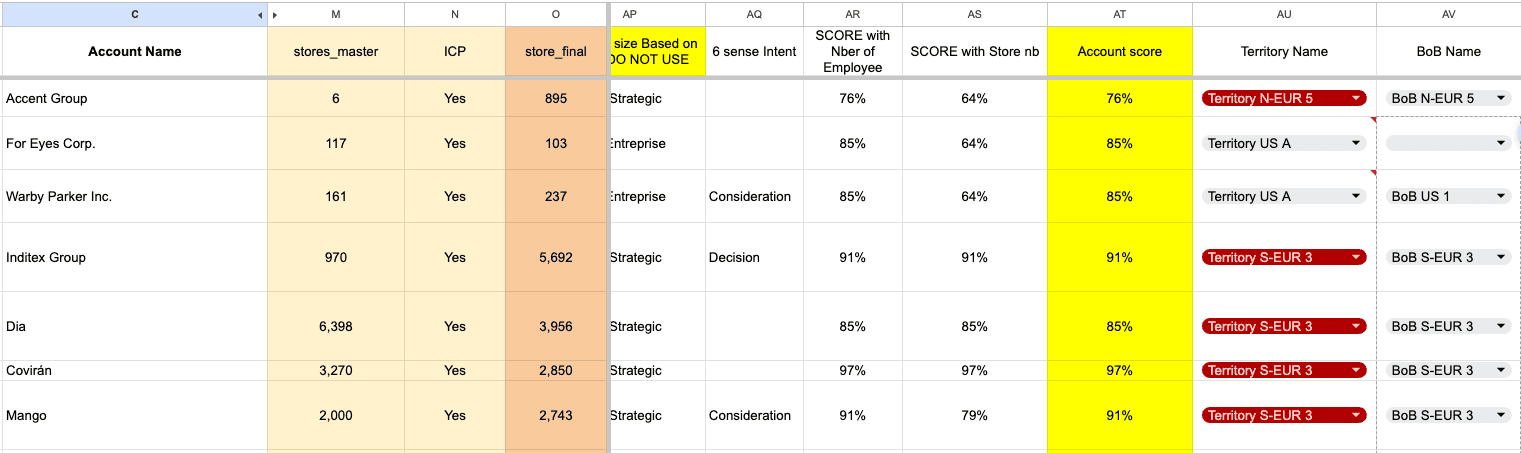
Result:
- Senior reps got assigned “theme” territories (e.g., “fashion chains, $500M+ revenue, high seasonality”)
- Lower-fit accounts were pushed to automated marketing/sales sequences, or assigned to junior reps
- Reps stopped wasting cycles on dead accounts, and saw 2x higher conversion rates in priority segments
Operator tip: When a new account signal comes in (e.g., company opens 100 new stores), it instantly moves up the list (prioritize the account). Your team is first to know and first to act.
5. Conclusion #
Custom data lets you understand your market in ways generic third-party lists never could. With LLMs, you can generate unique datasets and build smarter tiering, making your GTM radically more efficient.
The real winners will be the teams that don’t just collect custom data but actually use it to drive smarter orchestration.
If you want to rise above the noise and actually win, build your own custom data engine. That’s exactly what Cargo is built for.
Key Takeaways #
- Third-party data is commoditized, inaccurate, and overly broad: Everyone has ZoomInfo/Apollo (competitors have same data), outdated info (lead left 6 months ago), broad categories (“Software Development” lumps distinct segments). LLMs now outperform providers on public data, Perplexity provides 40% more “annual revenue” data than Apollo (Syftdata analysis)
- LLMs unlock custom, business-specific datapoints at scale: Extract from public web, press releases, job boards, investor reports. Examples: Vanta (SOC2 Type II status?), Rippling (hiring outside HQ?), Sweep (sustainability initiatives?), Yoobic (physical store count?). Custom data = edge competitors don’t have, context that moves needle
- Framework: Extract → Operationalize → Refresh: Extract (find custom datapoints for business-specific needs via LLMs, use 0-10 likelihood scales + confidence scores for hard-to-retrieve data), Operationalize (wire into scoring, routing, messaging), Refresh (real-time adaptation, stale data = dead data)
- 1% operators wire custom data into entire GTM engine, not just micro-campaigns: Score accounts by custom attributes + dynamic signals (not static firmographics), redesign territories by deal potential/strategic fit (not geo/size), trigger sequences speaking to prospect’s real world. Example: RetailCo territory planning (physical stores, revenue seasonality, store format, headcount growth) → 2x higher conversion in priority segments
- Custom attributes power dynamic scoring & tiering for resource allocation: Scoring = living system (company doubles SDR headcount → model recalculates → account moves up). Tiering = right resources (human vs AI agent) by revenue potential. Example: Vanta leads with SOC2 gap message, Deel targets 6+ country hiring without legal entities, resonates because it’s specific friction, not generic pain
Frequently Asked Questions #
Three fatal flaws:
1. Commoditized: Everyone has ZoomInfo, Apollo, Clearbit. Your competitors run the same lists → same outreach → zero differentiation. Third-party data is table stakes, not edge.
2. Inaccurate/outdated: Missing or stale information on headcount, revenue, role changes. Example: Check lead on LinkedIn before outreach → they left 6 months ago. Data decay rate is 30%+ annually, contacts change jobs, companies pivot, funding rounds happen.
3. Overly broad: Categories like “Software Development” lump SaaS, consulting, dev shops, and agencies together. Legit enterprise SaaS companies often miscategorized. Can’t segment effectively when everyone’s in same bucket.
LLM reality: Perplexity provides 40% more “annual revenue” data than Apollo for publicly available info (Syftdata). LLMs read press releases, investor reports, job boards, sources providers miss or update slowly.
Sales engagement tools: Number of reps, AE/BDR split, GTM stack (Salesloft vs. Outreach), outbound/inbound pipeline mix, sales enablement headcount → Tells you: mature sales org, budget for tooling, pain points.
Fintech: FX risk (operating in multiple countries), treasury team presence, current payment processor → Tells you: cross-border complexity, pain with existing solution.
AI dev tools: Junior/senior dev ratio, ML hiring, DevOps stack (IDE, CI/CD), engineer headcount growth/decline → Tells you: technical sophistication, “do more with less” angle if shrinking, expansion angle if growing.
Retail tech: Physical store count, seasonality (spiky vs. steady revenue), new market entries, owned vs. franchised stores → Tells you: scale, operational complexity, expansion ambitions.
Compliance tools (Vanta): Target market (SMB vs. enterprise), SOC2 status (Type 1, Type 2, none), customer logos → If selling to Ramp/Miro without SOC2? Deal-killer. Lead with compliance gap.
Ask yourself: “If I had 10 companies, what attribute makes one ‘perfect fit’ over others?” That’s your custom datapoint.
Process:
- Define datapoint: Be specific, not “Does company care about compliance?” but “Does company have SOC2 Type II certification?”
- Provide sources: LLMs work best with URLs (company website, LinkedIn, Crunchbase, press releases). Tools like Perplexity or Cargo Agent auto-scrape.
- Use likelihood scales for fuzzy data: If exact answer hard to retrieve, ask “On scale 0-10, how likely is {{company_name}} hiring remotely?” + request confidence score + explanation.
- Structure output: Get structured data (JSON, CSV) for CRM import. Example:
{"company": "Acme", "soc2_type2": false, "confidence": 0.85} - Validate: Spot-check 5-10% manually. If confidence < 0.7, flag for human review.
Cargo Agent workflow: Define datapoint → Provide company list → AI scrapes sources → Extracts structured data → Pushes to warehouse/CRM → Refreshes monthly/weekly.
Cost: ~1-5 per lead for traditional enrichment).
Most teams (99%): Use custom data for one-off campaigns. “Hey, saw you’re hiring remote workers” → 50 emails → Done.
1% operators: Wire custom data into GTM engine foundation:
1. Dynamic scoring: Every account scored by custom attributes + signals (not just firmographics). Example: Vanta scores accounts by: Target market (enterprise = +10), No SOC2 = +15, Growing fast = +5. Score updates real-time as data refreshes.
2. Territory redesign: Not by geo/size but by strategic fit. RetailCo example: “Fashion chains, 50M, steady” = Junior AE or automation.
3. Trigger workflows: Account doubles SDR headcount? → Auto-enrich all sales leaders → Route to AE → Sequence: “Scaling your sales team? Here’s how [competitor] ramped faster with [solution].”
4. Personalized sequences: Not “Hey, saw you’re in SaaS” but “Hiring in 6+ countries without local entities? Companies like [logo] hit this wall, here’s how they solved it.” Highly relevant automated outreach outperforms generic signal-based.
Result: Custom data becomes living infrastructure, not static list.
Old playbook: Assign territories by region (West Coast, EMEA) or company size ($10M-50M ARR). Static, doesn’t reflect actual fit or potential.
Modern playbook (RetailCo example):
Step 1, Define SAM with custom attributes:
- Physical store count (10-500 stores = sweet spot)
- Revenue seasonality (high seasonality = better fit for product)
- Store format (owned vs. franchised, owned = faster decision)
- Headcount growth (growing = expansion budget)
Step 2, Build dynamic account score: Refresh monthly as data updates. Score = fit + signals + momentum.
Step 3, Assign by theme, not geo:
- Senior AEs → “Fashion chains, $500M+ revenue, high seasonality”
- Mid-tier AEs → “Retail tech, 50-200 stores, steady growth”
- Automation/Junior → Low-fit accounts
Step 4, Real-time re-routing: Account opens 100 new stores? → Score jumps → Auto-assigned to top rep → Slack alert → Rep acts within 24hrs (first mover advantage).
Result: 2x higher conversion in priority segments, reps stop wasting time on dead accounts, territories self-optimize as market shifts.
 MaxSept 11, 2025